SEO used to feel more straightforward. You found a keyword, wrote a blog post, added a few links, and waited for Google to notice it.
But the way people search has changed. People still use Google, but now they also ask questions in tools like ChatGPT, and Google Search also shows AI-generated answers through AI Overviews.
This means your website content needs to do more than target keywords. It needs to answer real questions clearly, because both search engines and AI tools look for content that is useful, readable, and easy to understand.
There is more to SEO than what we cover here. But for beginners, these are the most important factors to understand first: keywords, helpful content, money pages, content clusters, internal links, and trust.
From our experience, the websites that grow are not always the ones publishing the most content. They are the ones that answer real questions, guide readers to the right pages, and build trust step by step.
Good SEO is not just about getting found. It is about being understood when people find you.
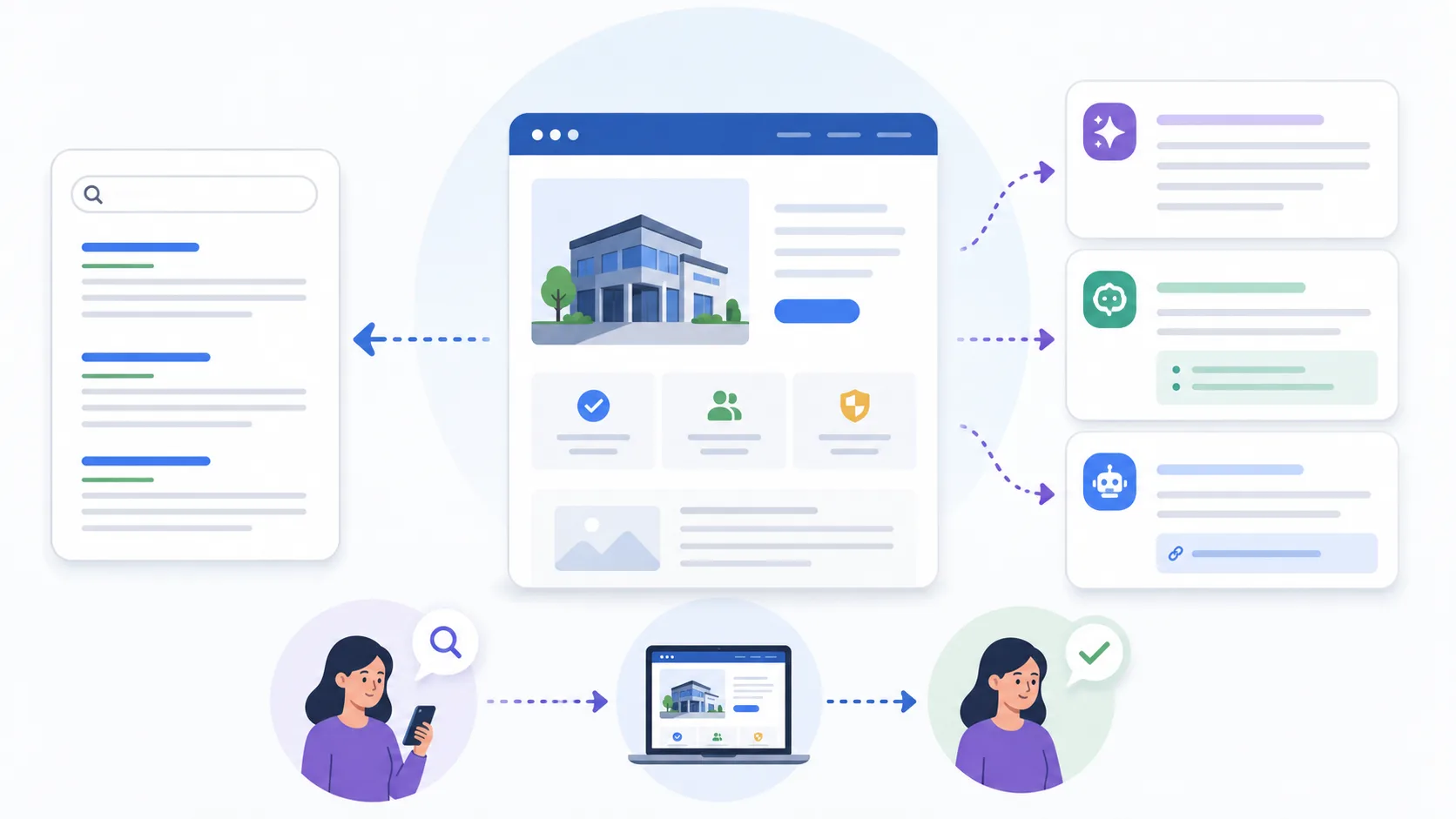 One strong website can support Google search, AI search, and real customer journeys.
Why Does SEO Still Matter?
SEO still matters because people search before they take action. They search when they are looking for something, comparing options, or need a clear answer to a question.
The platform may change, but the need is the same. People want answers they can trust without wasting time.
This is where good SEO helps. It makes your content easier for readers, search engines, and AI tools to understand.
A beginner should not think of SEO as a trick. It is better to think of it as a way to organize helpful answers on your website.
How Is Search Changing Today?
Search is no longer happening in one place. A customer may see a problem on social media, ask an AI tool for advice, check Google, read reviews, and then visit your website.
This is not completely new. The value of helpful content was always there, but older SEO strategies often focused heavily on backlinks and technical signals because they were easier to measure.
That approach is no longer enough on its own. If your content does not truly answer what people are looking for, it becomes harder for both readers and AI systems to trust it.
A better approach is to build a clear content plan around your audience’s questions. Each page should have a purpose, a clear message, and a natural next step in the customer journey.
A strong search strategy should help you:
-
Answer real customer questions
-
Build trust before the sale
-
Keep your messaging consistent
-
Guide readers toward useful next steps
-
Make your website easier for AI tools to understand
Where Should Beginners Start First?
Beginners should start with keyword research because it removes guesswork. It shows what people already search for and what problems they want solved.
If you do not know which keywords to start with, look at your competitors. Check what pages they rank for, what questions they answer, and which topics bring them traffic.
You do not need to copy their content. The goal is to understand what your audience is already searching for and where your website can give a clearer, more useful answer.
You also do not need to chase broad keywords at the beginning. A keyword like “SEO” is too wide, too competitive, and too hard to turn into one useful page.
A better starting point is a specific keyword like “SEO strategy for small business websites.” It has a clearer audience, clearer problem, and better content direction.
Simple starting points:
-
Check what your competitors rank for
-
Find real questions your audience asks
-
Choose focused keywords with clear intent
-
Create one useful page for one main idea
-
Avoid broad topics until your site is stronger
The best beginner keyword is not always the biggest keyword. It is the one your audience actually needs answered.
Why Do Money Pages Matter?
Traffic is useful, but traffic alone does not grow a business. Visitors need a clear next step after they read your content.
That is why money pages matter. A money page is a page designed to help someone take action, such as booking a call, starting a trial, requesting pricing, buying a product, or contacting your team.
These pages can include service pages, product pages, pricing pages, comparison pages, or landing pages. They connect SEO traffic to business results.
A blog post can bring someone to your website by answering a question. A money page helps that person understand your offer and decide whether it is right for them.
From our experience, strong SEO works better when blog posts and money pages support each other. The blog builds interest, and the money page turns that interest into action.
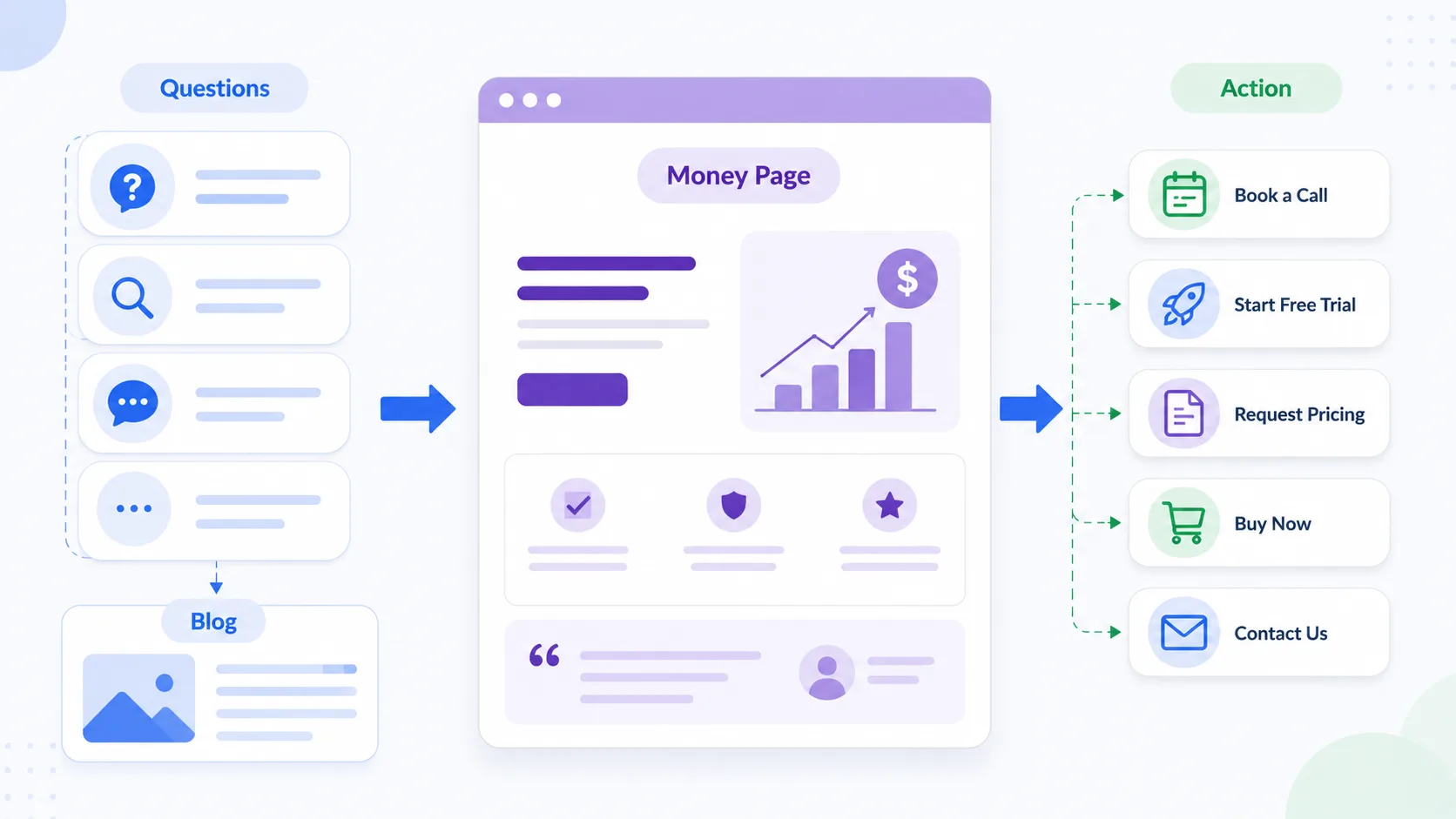 Helpful content attracts visitors, while money pages guide them toward action.
How Do Content Clusters Build Trust?
One blog post can answer one question. But a content cluster shows that your website understands the bigger topic, not just one small part of it.
A content cluster usually has one main page and several supporting articles. The supporting articles answer smaller questions and link back to the main page, so readers can move through the topic naturally.
For example, a main page about SaaS SEO can be supported by articles about SaaS keyword research, SEO landing pages, technical SEO, and content planning. This helps both readers and search engines understand your topic depth.
But one important thing to watch for is keyword cannibalization. This happens when two or more pages on your website target the same keyword or the same search intent, so they start competing with each other instead of supporting each other.
For example, if you publish three similar blogs about “SaaS SEO strategy” without a clear difference between them, Google may not know which page is the main one. As a result, all three pages may perform weaker than one strong page.
To avoid this, give every page a clear purpose before you write it. One page should target one main keyword or search intent, and related pages should support it through internal links.
Content without a plan is not automatically bad. A useful article can still help readers, but if your content is not connected by a clear plan, your messaging can become inconsistent over time.
When your content is connected properly, your website starts to feel more complete. That is how topical authority begins to grow.
A simple content cluster can include:
-
One main service or landing page
-
Several supporting blog posts
-
One clear keyword focus for each page
-
Internal links between related pages
-
Clear answers for different stages of the buyer journey
Content clusters work best when every page has its own job. If two pages are doing the same job, they may compete instead of helping each other.
What Makes On-Page SEO Easier?
On-page SEO sounds technical, but the beginner version is simple. Make every page easy to read, easy to scan, and easy to understand.
Start with your headings. A good heading should tell the reader exactly what the section will explain.
Then look at your internal links. If a blog mentions a service, product, or deeper guide, link to the page that helps the reader continue naturally.
Small details also matter, such as title tags, meta descriptions, image alt text, and short paragraphs. These details help both people and search systems understand the page faster.
Quick page check:
-
Does the title explain the page clearly?
-
Do headings answer real questions?
-
Are related pages linked naturally?
-
Is the main answer easy to find?
-
Does the page guide the reader to the next step?
How Can Links Build More Trust?
Links help show that your content is useful outside your own website. When other sites mention or reference your content, it can build credibility.
But beginners do not need to start with a complicated link-building campaign. The better first step is to create content that is actually worth referencing.
Original examples, expert quotes, case studies, useful data, and clear explanations can all make your content stronger. These details give other people a reason to link to your page.
In our experience, content earns more trust when it adds something useful instead of repeating the same advice everyone else gives. Even a small original insight can make a page feel more valuable.
If your content gives people something worth citing, link building becomes much easier.
What Should Your First Month Include?
A beginner SEO plan becomes easier when you break it into one month. You do not need to fix everything at once.
In the first week, research keywords, competitor pages, and customer questions. In the second week, plan your money pages and supporting blog topics.
In the third week, write or improve your most important pages. In the fourth week, clean up headings, internal links, meta descriptions, and image alt text.
By the end of the month, your website may not be perfect. But it will have a stronger foundation, clearer structure, and a better path for future content.
30-day beginner SEO plan:
-
Week 1: Research keywords, competitors, and customer questions
-
Week 2: Plan money pages and supporting content
-
Week 3: Write or improve key website pages
-
Week 4: Optimize headings, links, metadata, and images
Why Does Consistency Matter Most?
SEO usually does not show big results in the first few days. In many cases, the first few weeks can feel slow because Google needs time to crawl, understand, and trust your content.
This is where many beginners stop too early. They publish a few pages, do not see fast growth, and assume SEO is not working.
From our experience, the early stage is mostly about building the foundation. Your first articles may not bring much traffic right away, but they help your website become clearer, more complete, and easier to understand over time.
That is why consistency matters. When you keep publishing useful content around the same topic, your website slowly builds authority and gives search engines more reasons to trust it.
A simple way to stay consistent is to create a realistic publishing rhythm. Even one strong article per week is better than publishing many random posts and then stopping.
To stay consistent, focus on:
-
Publishing on a realistic schedule
-
Improving old content when needed
-
Linking new articles to related pages
-
Tracking progress over months, not days
-
Staying focused on the same topic area
SEO growth often comes late. The content you publish today may become valuable weeks or months from now.
What Is The Final SEO Takeaway?
SEO is changing, but the main idea is still simple. Useful content wins when it answers real questions clearly.
Google and AI tools both need structured, trustworthy content to understand your website. Readers need the same clarity before they decide to trust your business.
Start with focused keywords, build strong money pages, support them with content clusters, and connect everything with internal links. When your website becomes easier to understand, it becomes easier to recommend.
Build content for people first, but structure it so search engines and AI tools can understand it too.
 Enlear