Why You Can’t Just Throw AI, Filler, or Code at a Blog and Call It Content
Developers can instantly detect fluff. AI-generated text without context, vague filler paragraphs, or code snippets dropped in without explanation don’t build trust, and they won’t drive results.
Credible research from the software development world shows why structured collaboration works, and the same principles apply to creating developer content. In both cases, success depends on coordination between specialized roles, clear ownership, and a shared process.
- 83% of digitally maturing companies use cross-functional teams to improve agility and innovation in product development (Deloitte, HR Fraternity). Developer content benefits from this same approach—bringing marketing, DevRel, engineering, and design together early produces higher quality output faster.
- Yet, nearly 75% of cross-functional teams are dysfunctional, failing on budget, schedule, specifications, customer expectations, or alignment with company goals (PipelineApp). The same breakdown happens in content pipelines when responsibilities are vague or communication is siloed.
Similarly, in developer content creation, unclear roles and poor collaboration lead to slow turnaround times, missed opportunities, and content that fails to connect with its intended audience. Applying the same structured, well-governed approach used in high-performing software teams helps content teams move faster, improve quality, and consistently meet business and audience needs.
1. Bulk Planning & Outlines — Your Rework Killer
The easiest way to avoid delays and confusion? Align before you write. Monthly planning gives the team a shared direction, allowing quick adjustments while still ensuring quality.
A proven planning framework:
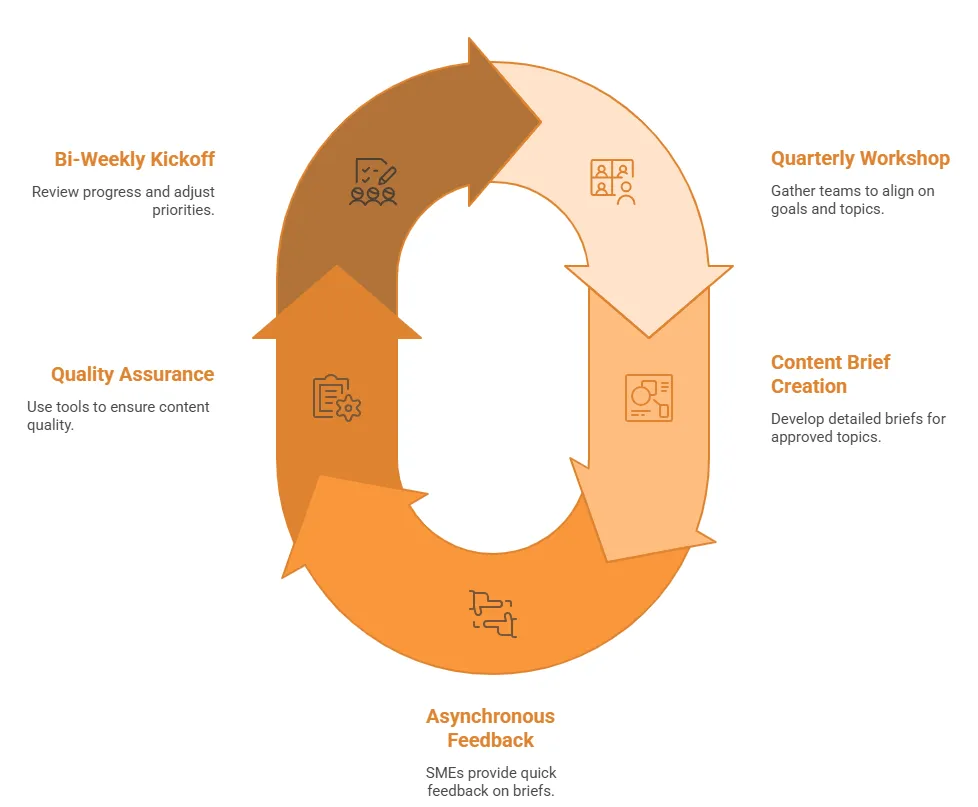
- Monthly Planning Workshop (60–90 min): Bring marketing, DevRel, SMEs, and design together. Update your persona vs. funnel matrix, review recent support tickets, keyword trends, and product updates. Vote on 3–5 topic clusters that serve both user needs and business goals.
- Create and Continuously Evolve a Brand Guide: Ensure your company has a clear, actionable brand content guide covering writing style, tone, formatting rules, terminology, and the beliefs or strong opinions your brand stands for. If your mission includes changing the world or building a developer community, make sure that vision is reflected consistently in all content.
- Not static: The guide should evolve with every piece of content. Review it at least monthly, incorporating learnings from writer feedback, content quality checks, and performance metrics (e.g., how each article ranks or engages).
- Evaluatable checkpoints: Turn the guide into measurable questions like “Does the intro clearly state the value for developers?”, “Are code examples following our formatting standard?”, “Does the closing reinforce our brand belief?”
- AI-assisted review: Use AI to check content against these checkpoints before final review.
- Factual correctness checks: Use AI where it excels, validating facts sentence-by-sentence or paragraph-by-paragraph, instead of scanning the entire article at once. This approach yields higher accuracy and catches subtle errors earlier.
- 24-Hour Turnaround: The content lead converts each cluster into a Trello or Notion card with a one-page brief containing working H2s, code example ideas, and early visual concepts. SMEs review asynchronously with quick thumbs up/down.
- Quality Guardrails & Content Management: Use tools like Grammarly, Surfer, Semrush, Ahrefs, Markdown/vale linters, and WriterGate to catch typos, formatting issues, and syntax errors early while also managing briefs, drafts, feedback, and approvals in a single place.
- Bi-Weekly Kickoff (15–20 min): Review the board, check in-progress work, and adjust priorities if needed based on product or industry shifts.
When everyone starts with a locked outline, a living brand guide, and clear priorities, writing, design, SEO, and SME work can happen in parallel cutting cycle time by 40% or more.
2. Produce in Parallel — Minimize Stop-and-Wait Queues
Traditional workflows often stall because each stage waits for the last to finish. Instead, start in parallel as soon as the outline is approved:
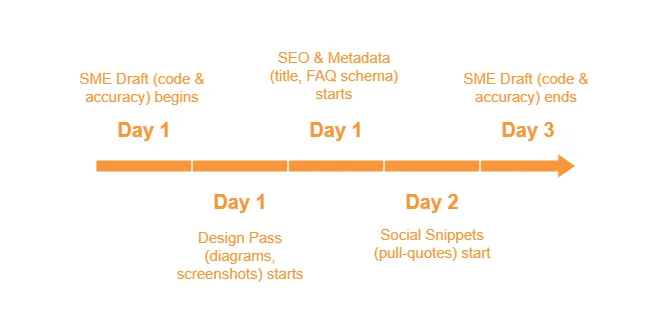
- SME Draft (Days 1–3): Developers add code blocks, commands, and examples from the outline—no need for a polished draft yet.
- Design Pass (Starts Day 1): Designers begin visuals and diagrams from the outline and early draft.
- SEO & Metadata (Starts Day 1): The SEO lead writes meta titles, headers, alt text, and schema immediately.
- Social Snippets (Starts Day 2): Marketing pulls quotes, stats, and takeaways for social posts before the draft is finalized.
Parallel work removes blockers, shortens timelines, and keeps momentum high.
Still, there will be times when blockers appear, priorities shift, or repetitive fixes start to add up. In these situations, it’s critical to:
- Identify the root cause — Was the delay due to unclear requirements, missing assets, dependency on another team, or late-stage changes?
- Apply a “shift left” approach — Move quality checks, reviews, and alignment steps earlier in the process so potential issues are caught before they cause rework. For example:
- Involve SMEs earlier to validate technical accuracy before writing begins.
- Review visual concepts during outline approval instead of after the draft.
- Pre-check SEO metadata against the outline to avoid late-stage edits.
By shifting problem detection and validation earlier in the workflow, you reduce downstream friction and keep your content pipeline moving smoothly.
3. One Owner per Stage
When ownership is unclear, work stalls. The Content Manager should be the overall owner—leading execution, ensuring every content piece is delivered, following up with all contributors, and keeping the process on track.
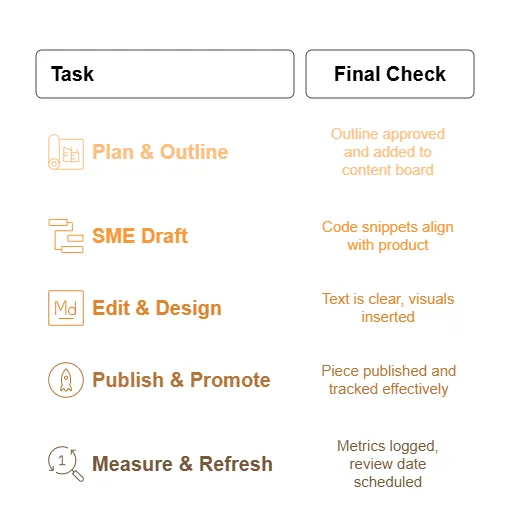
- Content Manager: Oversees the full process from planning to publish, approves outlines, ensures execution stays on track, monitors performance, logs key metrics, and schedules reviews.
- Developer/SME: Produces technical examples and ensures accuracy. If internal developers are not enough, you can approach outside individuals or companies like Enlear to bridge the gap.
- Editor & Designer: Refine messaging, visuals, and clarity.
- Marketer: Publishes content, applies tracking, and preps promotional assets.
Having a single accountable owner (the Content Manager) ensures smooth progress from idea to publish with no confusion over who’s responsible.
4. Setting Deadlines & Managing Reviews
Deadlines create clarity and accountability. Start with your content calendar, then set specific due dates for each stage writing, design, review, and publishing. Build in a buffer period to handle inevitable back-and-forth, especially during reviews.
One key to faster progress is reducing unnecessary review cycles. As a principle:
If a reviewer can make a small fix directly without changing the author’s intent, they should fix it instead of sending it back for revisions.
Feedback is still essential for helping writers improve their craft and align with your brand voice, but balance is important. Provide enough constructive feedback to help the writer grow, while also avoiding drawn-out review loops that slow delivery. Keep reviews focused on substantive improvements, fix small issues in place, and move the piece forward.
5. Ten Gear Strategies to Keep the Flywheel Turning
Once your system runs smoothly, scale without burning out contributors or sacrificing quality.
- Map the Audience Journey – Use a persona vs. funnel matrix to target the right person at the right time.
- Create Topic Clusters – Build around core themes with pillar posts and 5–10 related articles.
- Expand the Writer Pool – Blend in-house SMEs, guest contributors, and freelance editors.
- Match Writers to Outlets – Assign based on expertise and format to reduce rewrites.
- Bake Quality into the Workflow – Use checklists, style guides, and linters to avoid basic errors.
- Build a Single Source of Truth – Manage briefs, drafts, and feedback in one shared board.
- Run Tasks in Parallel – Let all roles start once the outline is approved.
- Automate the Grunt Work – Use tools for editing, formatting, and design setup.
- Measure and Learn – Track metrics like keyword share, scroll depth, and stage time.
- Refresh and Repurpose – Update top content quarterly and adapt into new formats.
Measure Business Impact — Not Just Velocity
It’s not enough to publish more; you need to know if the content is driving results. This means tracking the right data continuously:
- Organic visibility (keyword share)
- Engagement health (scroll depth, assisted conversions)
- Pipeline efficiency (cards blocked, days in column)
SEO tools like Semrush and Ahrefs also let you track keyword positions over time, monitor whether each article ranks on the first page of Google, and spot drops in rankings early so you can take corrective action. This ongoing monitoring ensures your developer content continues to perform after it’s published.
Velocity signals productivity. Impact proves value.
Conclusion
You can’t just throw AI, filler, or code into a blog and call it content. Developer audiences demand accuracy, operational discipline, and a system that supports both.
When you bulk plan monthly, lock outlines, build and continuously evolve a brand guide, set deadlines with buffers, assign clear ownership to a single Content Manager, use quality guardrails like Grammarly, Surfer, Semrush, Ahrefs, Markdown/vale linters, and WriterGate, and run parallel workflows with a “shift left” mindset, you create a faster, more predictable pipeline. Add topic clusters, quality automation, AI-powered factual checks, and continuous performance tracking, and you’ve built more than a process you’ve built a scalable, high-trust content engine that consistently earns credibility with technical audiences.
 Enlear