Quality developer content is a strategic asset. It builds credibility through accurate technical writing. It supports product adoption by making it easier to understand and use. It improves SEO through consistent, high-quality publishing.
 When maintaining constant quality in developer content, the challenge is combining technical depth with clear marketing. So, they either make it too simple and miss the point or overcomplicate and lose the audience. That's why most teams struggle to do both well without losing clarity or precision.
Why Quality Matters in Developer Content
Have you ever wondered what developers really need from content?
It's not just information. Developers rely on content to learn quickly, fix issues on the fly, and choose the right tools. Think of it like this: if content is their compass, poor-quality content sends them in the wrong direction, wasting time, creating confusion, and damaging trust.
So, what is high-quality developer content?
Its content is that:
- Solves real problems clearly and efficiently.
- Builds trust by being accurate, honest, and useful.
- Encourages action, whether it's trying a tool, signing up, or integrating a solution.
Imagine you’re launching a new API. Now ask yourself:
Would a developer trust your product after reading a confusing tutorial or outdated documentation? Probably not.
But wait, quality isn’t just about writing well or using clean code examples. You could have a beautifully written guide that no one ever reads. Why? Because it’s hidden, buried, or missing the keywords that developers search for.
That's where two silent heroes step in:
- Discoverability: Can developers find your content when they need it most?
- Business impact: Can you measure if your content actually drives sign-ups, usage, or engagement?
Without these, even the most polished piece might fall flat. “If it’s not seen, it doesn’t matter how good it is.”
Why People & Process Foundations
The Engine Behind High-Quality Developer Content
Behind every outstanding piece of developer content, there’s a system quietly at work. Not just a writer typing away, but a collaborative engine of people and process moving in harmony.
Let’s imagine for a moment you're publishing a guide on using your new SDK. Who’s involved?
- A subject matter expert (SME) explains the technology clearly.
- An editor ensures the language is easy to digest.
- A developer tests the examples to make sure they actually work.
- You, the marketer, shape the message and get it in front of the right audience.
It’s not about throwing content over the wall. It’s about orchestrating teamwork so the end result is both technically solid and strategically aligned.
How Early Alignment Boosts Content Quality
Ever had a content piece that went through endless edits and still missed the mark? You’re not alone. That usually happens when everyone dives into execution without first agreeing on the big picture.
So, what needs to happen early?
To avoid confusion later, get clear on the essentials up front:
- Who is this content for? (Beginner devs? Decision makers? Backend engineers?)
- What’s the goal? (Educate? Drive sign-ups? Inspire action?)
- What’s the angle? (Is it a how-to guide, a thought leadership piece, or a product announcement?)
- How will we measure success? (Traffic, signups, usage, feedback?)
Why does this matter to you?
Let’s say you're coordinating a new blog post with your product and dev teams. If the audience isn’t clear from the start, the SME might over-explain basics, or skip them entirely. If the goal isn’t defined, your team could spend hours polishing content that doesn't move the needle.
Early alignment solves this.
- It keeps iteration cycles short, less back-and-forth, more progress.
- It gives SMEs a clear execution path, so they know what to focus on.
- It helps everyone share the same definition of “done.” No more vague expectations.
Should Make Standards Stick
The Secret to Consistent, Scalable Content Quality
How do you make sure your content feels consistent, whether it's written by Alice from dev relations or Sam from support?
The answer: standards.
Think of them as your team’s content playbook. When everyone follows the same rules, the final output is clear, professional, and trusted every time.
What kind of standards are we talking about? Here’s what a strong content standard might include:
- Code style – Should it use tabs or spaces? TypeScript or JavaScript?
- Visuals – Are diagrams simple and readable? Do screenshots follow brand style?
- Tone and language – Is the voice friendly? Technical? Jargon-free?
- Formatting – Do all headers, callouts, and links follow a template?
Now layer in these helpers:
- Review SLAs – So no one’s waiting days for feedback.
- Automation tools – Linters, spellcheckers, and templates to catch issues before publishing.
Why this matters to you
Let’s say you’re scaling your content production. One month it’s 3 articles, next month it’s 30. Without standards? It becomes a wild mix of styles and tones that confuses your audience and weakens your brand.
With standards? You can confidently delegate, scale, and still publish high-quality content that feels like it came from one voice, even if 10 people were involved.
“Consistency breeds trust. Trust drives engagement.”
Tooling for Quality Assurance
Because Process Alone Isn’t Enough
You’ve got the team. You’ve got the workflow. But here's the catch:
Even with the best process, things still fall through the cracks unless you have the right tools to back it up.
Let’s break it down.
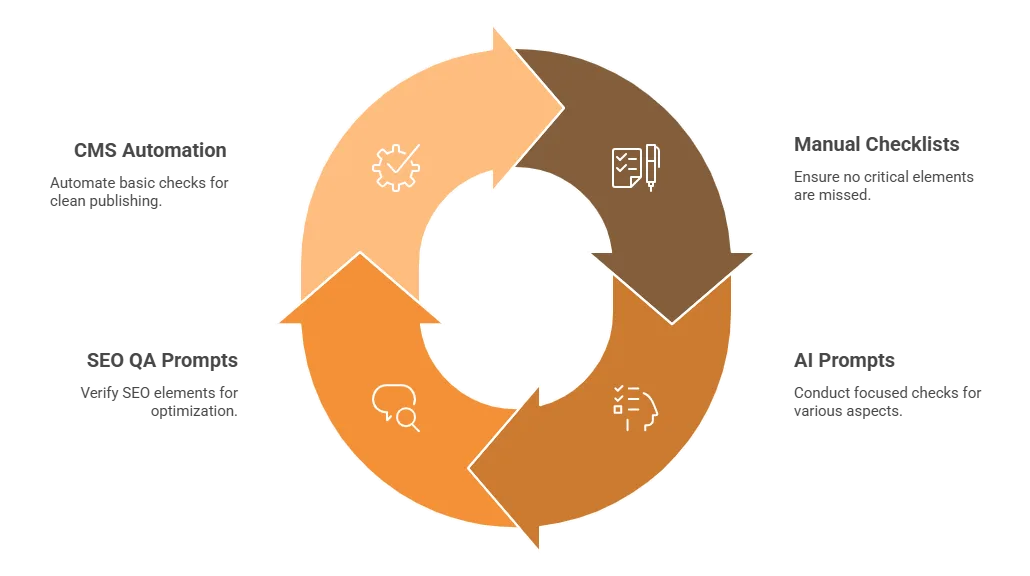
- Manual Checklists: Your Low-Tech Lifeline
Before anything goes live, a simple checklist does wonders. Ask yourself:
Are code snippets tested? Is the voice on-brand? Are all visuals clear and accurate?
Checklists act like seatbelts; they don’t stop you from driving fast, but they keep things safe when you do.
- AI Prompts: Your On-Demand Assistant
Want to catch grammar hiccups, tone shifts, or unclear phrasing?
Use modular AI prompts tailored to:
Fix grammar and spelling, Check for consistent tone (is it friendly, confident, technical?) & Flag inaccuracies or outdated references
- SEO Prompts + CMS Automation: Your Final Gatekeepers
Before hitting “Publish,” make sure:
SEO prompts validate your titles, headings, and keyword usage, and CMS-integrated tools scan for broken links, missing meta tags, and unoptimized images
These tools aren’t just nice to have, they catch issues humans miss, especially when you're scaling fast.
 ## Why Audit & Iterate with Metrics
Let Data Be Your Guide, Not Guesswork
How do you know your content is working? Is it just because it feels good, or because the numbers back it up?
When it comes to developer content, data is your quality compass. Without it, you're flying blind. With it, you’re steering with purpose.
Step 1: Track performance with real data
Start by paying attention to metrics that tell a story:
- Engagement – Are developers spending time on your page or bouncing off?
- Read time – Are they reading it through or skimming and leaving?
- Bounce rate – Are you solving their need or leaving them frustrated?
- SEO performance – Can they even find your content in the first place?
Step 2: Run regular content audits
Don't wait until something breaks. Every few months, ask:
What’s performing well? What’s outdated or inaccurate? What needs a refresh?
Imagine finding that your top-trafficked post still mentions deprecated functions. A simple update could prevent confusion and support your credibility.
Step 3: Feed those insights back into your system
Audits aren't just for ticking boxes. Use what you learn to:
Improve your content process, Fine-tune your tools and templates, Provide feedback to SMEs and editors so future content gets stronger.
Step 4: Create a continuous feedback loop
This is where magic happens. When you let data shape your next decisions, quality becomes not just a goal, but a habit.
Should Publish needs Visibility
Small Setup Tweaks That Make a Big Impact
You’ve written great content. The team reviewed it, polished it, and it's technically solid. Now what?
If it doesn’t show up in search results, or loads too slowly on mobile, or isn’t in the right format, you’ve just built a brilliant billboard in the desert.
This part is all about: Visibility + Experience
To make your content reach the right audience and work for them, you need to set it up for success. Here’s how:
Ask yourself:
Is this a blog, a help doc, or a tutorial? Each format serves a different purpose. Match the structure to the reader’s expectations so they don’t bounce.
Canonical URLs prevent duplicate content issues.
Schema markup helps search engines understand and feature your content.
Meta tags and smart headings guide both Google and developers.
- Make it lightning-fast on all devices
Developers are often on the go or multitasking with 20 tabs open. If your content doesn’t load quickly on mobile, tablet, or even poor Wi-Fi? You lose them in seconds.
Why does this matter to you
You could have the best guide on the internet but if no one can find it, open it, or trust it at first glance...it won’t deliver value.
But with just a few small tweaks, More developers discover your work, More of them stay and engage, your content becomes a real asset, not just a checkbox.
Scaling Without Sacrificing Quality
Don’t Scale with Pressure, Scale with Support
Trying to grow your content output by pushing harder? That only leads to two things: burnout and sloppy content.
The problem:
- Rushed content misses the mark.
- Teams lose confidence under pressure.
- Quality becomes unpredictable.
The better way:
Support your team with smart systems:
- Templates that eliminate guesswork.
- Checklists that catch mistakes early.
- Editors who coach instead of just correcting.
These tools don’t slow you down, they give your contributors clarity, speed, and confidence.
“The goal isn’t more content. It’s better content, created sustainably.”
Polished & Professional
Evolve the System or Watch It Break
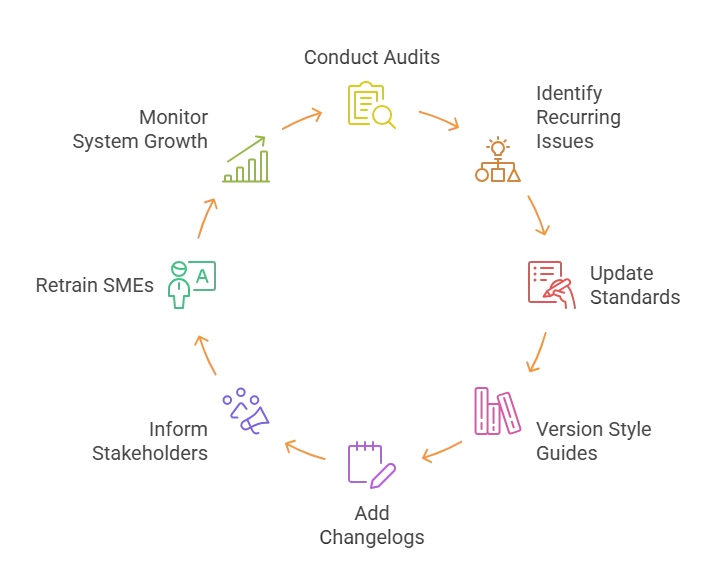
Even the best content systems can go stale. If your audits keep surfacing the same issues, that’s a signal, not just noise.
Time to refresh:
- Update your standards when old ones stop working.
- Version your style guides so everyone knows what changed—and why.
- Add changelogs to keep the team aligned and up to date.
And when expectations shift? Re-train your SMEs. Don’t leave them guessing; set them up to succeed.
 Enlear