//
AWS Enlear
Authentication vs Authorization in AWS Amplify
EnlearAuthentication vs Authorization in AWS Amplify
Why Permissions Feel Confusing in Amplify
June 25, 20267 min readRead
AWS DynamoDB Eventual Consistency VS Strong Consistency Amazon DynamoDB reads data from tables, local secondary indexes (LSIs), global secondary indexes (GSIs), and streams. Both tables and LSIs …
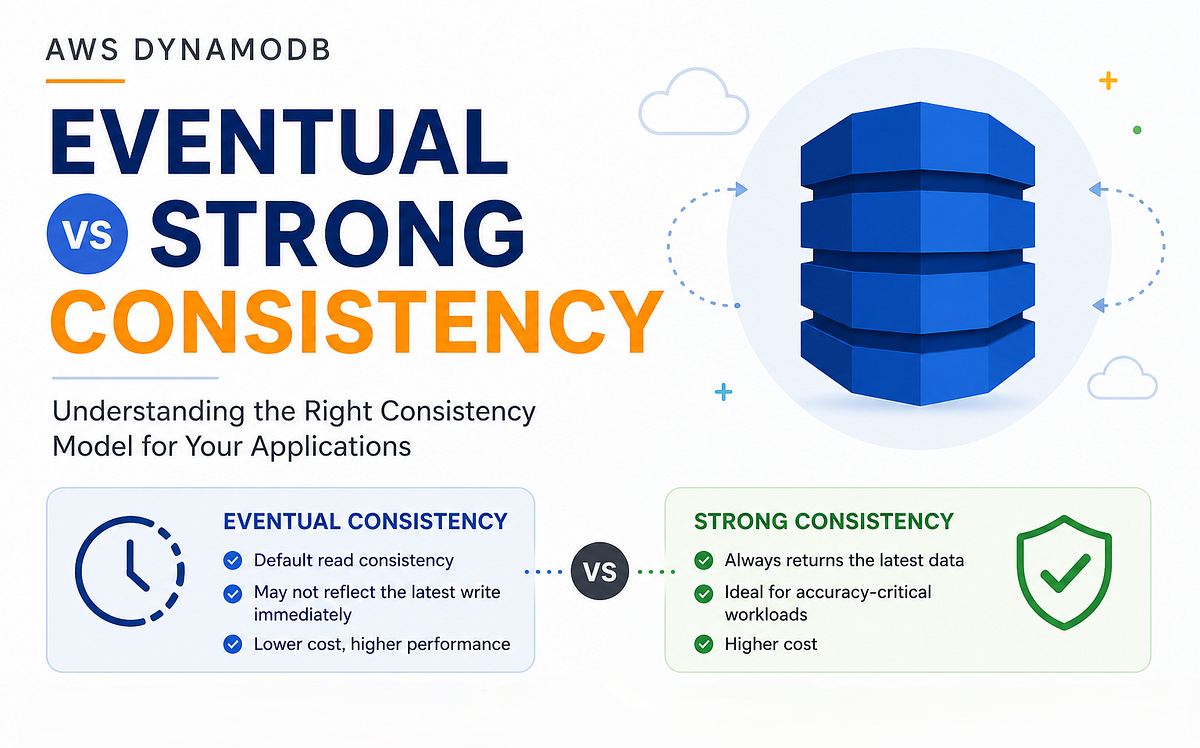
Amazon DynamoDB reads data from tables, local secondary indexes (LSIs), global secondary indexes (GSIs), and streams. Both tables and LSIs provide two read consistency options: eventual consistency (default) and strong consistency.
Imagine updating a profile picture. But when you refresh the page, it still shows the old one. A few seconds later, it updates. That delay isn’t a bug, it’s a design decision.
Welcome to the world of consistency models in distributed systems, and how Amazon DynamoDB handles them.
In distributed databases, consistency refers to how up-to-date your data is when you read it after a write. When your application writes data to DynamoDB and receives an HTTP 200 (OK) response, the write is successfully completed and durably persisted.
DynamoDB also guarantees read-committed isolation, that means you will never read uncommitted or failed data and every read reflects a value from a successful write
However, this does not guarantee that you always read the latest value immediately. That’s where consistency models come in.
By default, DynamoDB uses Eventually Consistent Reads. This means a read request may not reflect the most recent write immediately**. **If you retry after a short time, the updated data will appear.
Think of it like syncing messages across devices. Your phone updates instantly, but your laptop may take a second.
Eventually consistent reads cost about half as much as strongly consistent reads.
Strongly consistent reads guarantee that you always get the most up-to-date data.
When you set:
ConsistentRead = true
DynamoDB ensures your read reflects all successful prior writes and no delay between write and visibility.
Think of checking your bank balance. You expect to see the exact current value, not something from a few seconds ago.
DynamoDB also supports Global Tables, allowing data replication across multiple AWS regions.
Use Eventually Consistent Reads when you are building high-scale applications, slight delays are acceptable and cost optimization is important
Examples:
Use Strongly Consistent Reads when data accuracy is critical, users must see the latest value immediately and decisions depend on real-time data
Examples:
DynamoDB doesn’t force you to choose between performance and accuracy. It gives you both, with clear trade-offs. Understanding when to use eventual vs strong consistency is what separates a system that simply works from one that is truly well-designed. Sometimes, a slight delay is perfectly acceptable. Other times, it can’t be tolerated. Knowing the difference is what makes you a better engineer.
A version of this article was first published on May 11, 2026 on Medium.
EnlearWhy Permissions Feel Confusing in Amplify
EnlearWhat Is Amazon EC2? A Beginner’s Guide to Virtual Servers in AWS Amazon EC2 (Elastic Compute Cloud) is a service that provides virtual servers, called instances, in the cloud. You can choose the …
EnlearWhat is Amazon Bedrock AgentCore?