
( )
TOFU
How Do You Plan Social Media Content for TOFU, MOFU, and BOFU in Developer Marketing?
Enlear
How Do You Plan Social Media Content for TOFU, MOFU, and BOFU in Developer Marketing?
October 14, 20265 min readRead
Is developer marketing dying because of AI? Explore how AI is changing technical content creation and why human expertise, trust, and experience still matter.
Is Developer Marketing Dying Because of AI? We Don’t Think So
AI has changed how we do developer marketing. We can research topics faster. We can turn rough notes into an outline in minutes. We can draft social posts, summarize documentation, find different ways to explain a technical idea, and produce more content with a much smaller amount of manual work. So it is reasonable to ask a harder question:
If AI can do so much of this work, do we still need developer marketing?
From what we have seen, the answer is yes. But the type of developer marketing that worked a few years ago is becoming less valuable. AI has made content production easier. It has not made developers easier to understand. And that difference matters.
There is no point pretending AI has had a small impact. A lot of work that used to take hours can now be done much faster. Research is easier. First drafts are faster. Repurposing one technical article into several social posts is easier. Even basic keyword research, competitor analysis, and content planning can be accelerated with AI.
For marketing teams, that is useful. But it has also created a new problem. If every company can produce ten articles instead of two, simply producing more content stops being an advantage. We have already reached a point where generating a technically reasonable article is not particularly difficult. Give an AI tool a topic such as Kubernetes security, MCP, API authentication, or AI coding agents and it will usually return something that looks convincing.
The question is no longer
Can we create this content?
The better question is
Why would a developer trust ours?
That is where developer marketing still needs people.
This is something we keep coming back to when working on technical content. A piece can have all the correct ingredients and shows them below
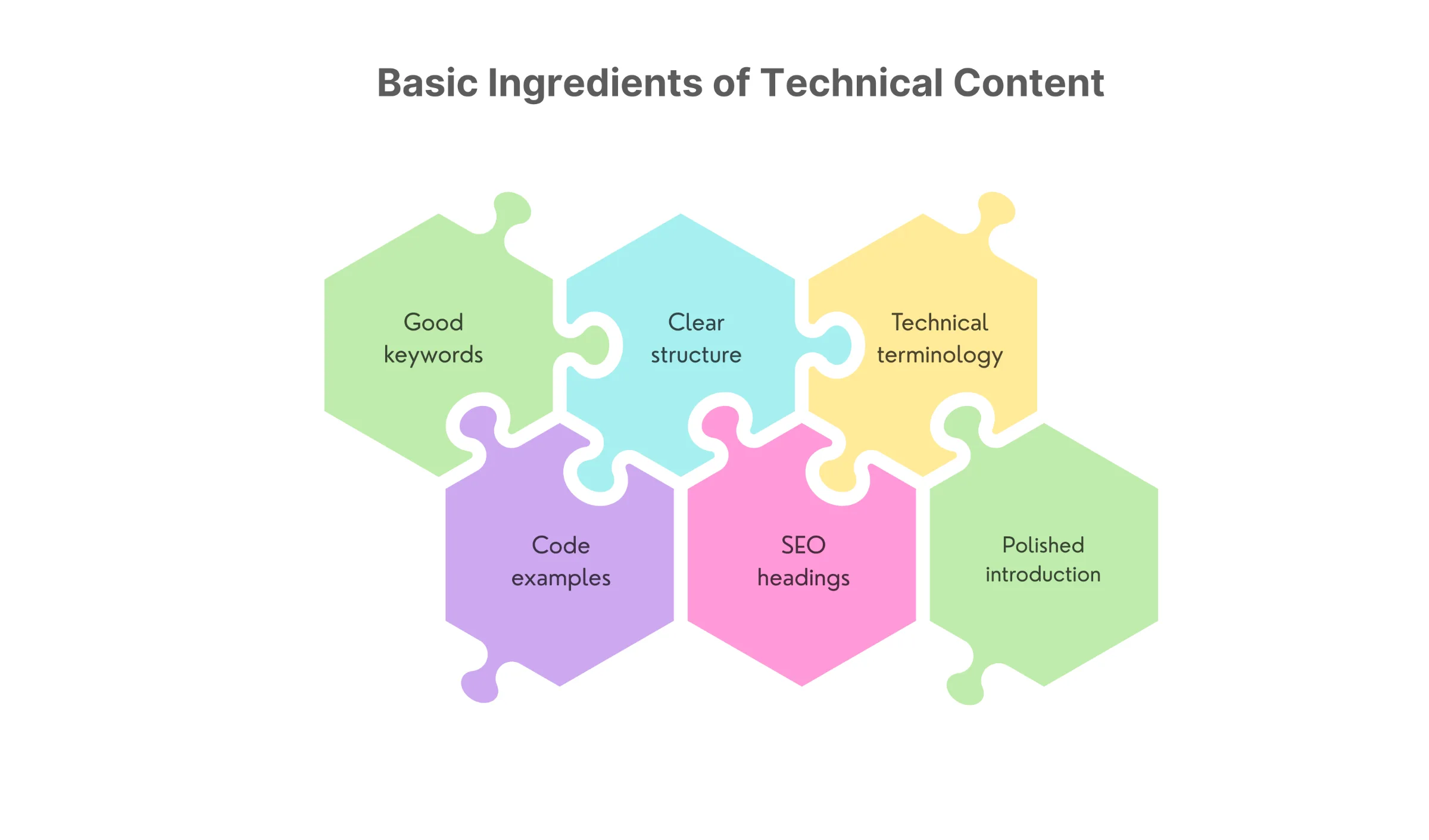
And it can still feel empty. Developers usually notice when someone is explaining a problem they have never actually dealt with. The difference often appears in small sentences. A generic article might say:
“Use monitoring to identify performance issues.”
Someone who has worked with the problem might say that the alert only showed where requests were failing, while the actual cause came from a code change deeper in the backend. That second explanation contains experience. AI can reproduce the language of experience. It is much harder for it to create the underlying judgment without good human input. That is why we do not think the future of developer marketing is about replacing people with AI-generated content. It is about using AI to remove repetitive work so people can spend more time on the parts that require experience.
This is also where we think some of the discussion around AI misses the point. Developer marketing is not simply writing blog posts for developers. Good developer marketing requires understanding:
What developers are struggling with
How they evaluate technical products
Which claims they will immediately question
What level of technical detail they expect
Where documentation ends and marketing begins
What engineers actually need before trying a product
AI can help collect information around all of these areas. But deciding what matters still requires judgment.
For example, a developer tool might have twenty features. Marketing could create a page for every one of them. That does not mean developers care equally about all twenty. Maybe the real concern is whether the tool works with an existing CI/CD pipeline. Maybe security teams need an on-premise option. Maybe developers want to know what happens when generated code fails in production. Those insights shape the marketing strategy. Generating the copy comes later.
This sounds strange at first. If AI can create more content, why would human input become more important? Because the amount of average content increases too. AI can explain what OAuth is. It can summarize an API. It can compare two common approaches. It can write a decent introduction to an engineering concept.
That means those things alone are becoming less valuable. The content that stands out tends to contain something harder to reproduce:
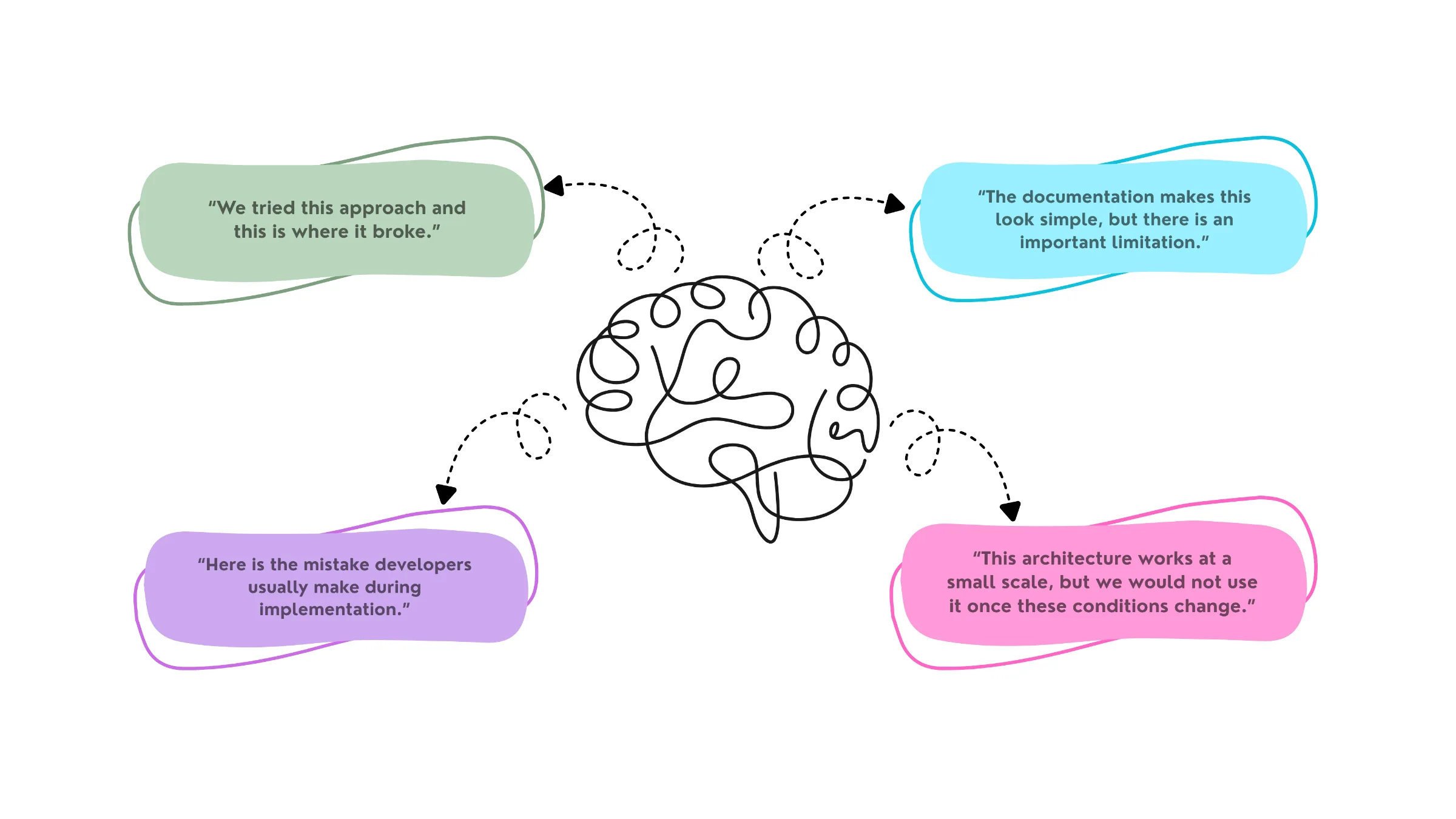 Those observations can come from engineers, customers, support conversations, product teams, or direct testing. Developer marketers need to find those details and turn them into useful stories. AI can help shape them. It should not be expected to invent them.
Developers are usually skeptical audiences. They do not automatically believe a claim because it appears on a polished landing page. Many will check the documentation, open the GitHub repository, search for issues, compare alternatives, or test the product themselves.
That makes trust especially important in developer marketing. If a company says its product makes integration “effortless,” developers may immediately look for what is being hidden behind that word. A better approach is often to show the actual integration process, explain the limitations, and be clear about where the product fits.
This is where the human side still matters. Understanding when not to exaggerate is marketing judgment. Knowing that a certain technical claim needs an engineer to verify it is judgment. Recognizing that a developer would rather see a real example than another list of benefits is judgment. AI can suggest all of those things. Someone still has to decide what is credible for the specific audience and product.
We do think some parts of developer marketing will become less important. Spending hours producing a basic outline is probably not a good use of time anymore. Manually rewriting the same announcement for five channels is becoming unnecessary. Writing another generic “What is X?” article when hundreds already exist is becoming harder to justify. The value is moving elsewhere.
Developer marketers increasingly need to be better at:
Interviewing engineers
Finding useful technical stories
Understanding product workflows
Turning engineering experience into content
Reviewing AI output critically
Connecting search intent with genuine developer problems
Deciding what should not be automated
That is a different job from simply producing content. In many ways, it is a more interesting one.
For a long time, content volume could itself create an advantage. Publish consistently, cover enough keywords, create enough educational pages, and eventually some of them would perform. AI has changed that equation because everyone can produce more. If five competitors can generate fifty reasonable articles this month, publishing article number fifty-one is not much of a strategy. We think the advantage is moving toward specificity.
One strong article based on an engineer's real experience debugging a production issue can be more useful than ten generic articles explaining the same concept. One honest comparison that explains where a product does not fit can build more trust than five promotional landing pages. One original technical observation can give developers something they could not get by asking an AI assistant for a summary. That is where human-led developer marketing still has room.
AI is making generic developer marketing less valuable by making repetitive, low-value content easier to produce. That pushes developer marketing closer to real product knowledge, engineering experience, and useful technical insight. AI can improve speed, but developers still trust accuracy, practical examples, honest limitations, and genuine experience.
How Do You Plan Social Media Content for TOFU, MOFU, and BOFU in Developer Marketing?
More Content or Better Content: What Actually Works in Developer Marketing?
Explore the problem that higher output does not automatically make technical content more useful or convincing. From what we have seen, publishing more without improving depth, accuracy, or relevance can weaken developer marketing rather than strengthen it.
Why AI-Written Technical Content Still Needs Developer Review
AI can produce a polished technical article in minutes, but it may still include inaccurate explanations, unrealistic examples, or missing limitations.