More Content or Better Content: What Actually Works in Developer Marketing?
Explore the problem that higher output does not automatically make technical content more useful or convincing. From what we have seen, publishing more without improving depth, accuracy, or relevance can weaken developer marketing rather than strengthen it.
Enlear Team
October 2, 2026
5 min read
[ ]
Developer Marketing
More Content or Better Content: What Actually Works in Developer Marketing?
Enlear
Developer marketing teams are often pushed to keep publishing across blogs, social content, and search-driven topics. The pressure is understandable because consistency, discoverability, and coverage across the evaluation journey all matter. The problem is that higher output does not automatically make technical content more useful or convincing. From what we have seen, publishing more without improving depth, accuracy, or relevance can weaken developer marketing rather than strengthen it.
Publishing More Used to Create a Clearer Advantage
For a long time, having a consistent publishing process gave developer companies a real advantage. If one company published one useful technical article every few months while another consistently covered integrations and industry questions, the second company naturally had more opportunities to appear in search and reach developers.
That logic still matters. The difference is that producing content is much easier now. AI can help research topics, create outlines, prepare first drafts, repurpose articles, generate social posts, and build multiple versions of the same campaign much faster than before. As a result, content volume is becoming easier for everyone to increase. That makes volume alone much less valuable.
We See More Content, But Not Always More Useful Content
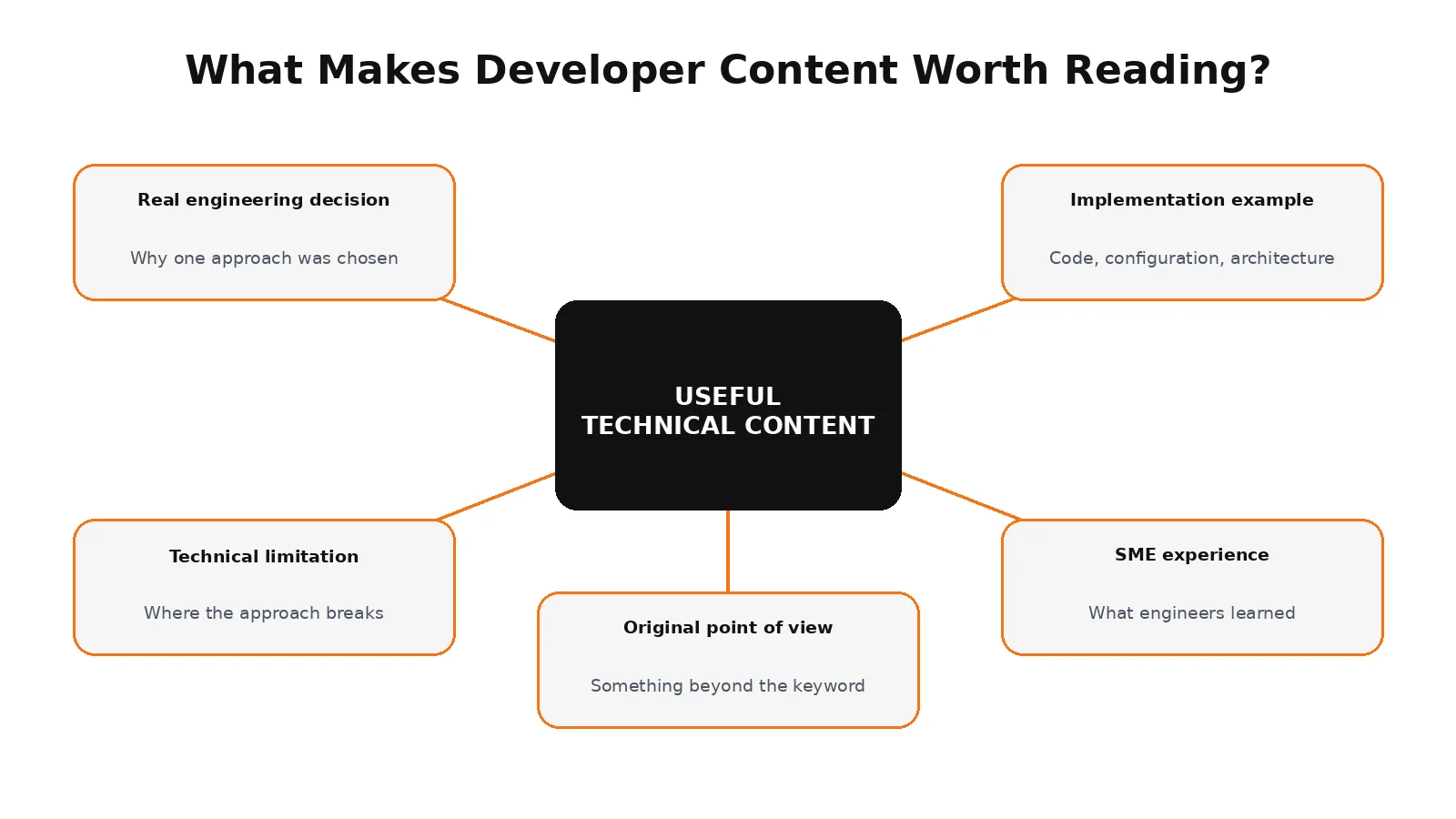
what makes content more useful
This is becoming obvious when researching almost any competitive developer topic. Search for observability, API security, AI coding tools, platform engineering, DevOps automation, or developer productivity, and you will often find several articles covering almost exactly the same points.
The titles are different, but the structure feels familiar. The introduction defines the problem. A section explains why it matters. Another lists five benefits. Then comes a best-practices section and a conclusion recommending that teams adopt a better approach.
There is nothing technically wrong with that structure. The problem is that after reading several articles, it becomes difficult to remember which company actually contributed something useful. We have seen this in technical content reviews too. An article can be well written, SEO-friendly, and factually correct while still adding very little to the conversation. For developer audiences, that is a problem.
Developers Usually Want an Answer, Not Another Article
Developers rarely search for "content." They normally have a problem. They may be trying to understand why an application behaves differently in production, compare two developer tools, debug an integration, evaluate an API, understand an architectural tradeoff, or decide whether a new platform is worth testing.
The content only works if it helps with that job. This is where we think many content strategies become too focused on publishing schedules. A team decides it identifies eight topics, it needs eight articles this month, so eight topics are found, and it produces eight articles. The content calendar is complete, but nobody asks whether developers actually needed all eight pieces.
That is the difference between content production and developer marketing.
Better Content Does Not Simply Mean Better Writing
When we talk about content quality, we are not talking about prettier sentences or more polished introductions. For developer marketing, quality usually comes from what is inside the article.
A strong technical article may include an engineering decision that was difficult to make, a limitation developers should understand before using a tool, a real implementation example, an architecture diagram, an SME explanation, or an opinion based on working with the problem directly. That type of content is much harder to reproduce. We usually ask a simple question during content planning:
What does this article contain that would not appear if another company used the same keyword and the same AI tool?
If the answer is nothing, the topic probably needs more work.
Experience Has Become More Important Because AI Can Generate the Basics
AI is useful in our content process. It can help organize research, improve structure, explore different angles, identify missing sections, summarize source material, and speed up repetitive parts of production. But we have found that the content becomes weaker when AI is asked to create the entire argument before anyone has decided what the company actually thinks.
The model can produce a reasonable answer very quickly. That is also the problem. Reasonable answers are becoming extremely common. The strongest technical content usually starts somewhere else. It starts with an engineer explaining what actually failed, a product team sharing why a feature was designed in a particular way, a customer question that keeps appearing, or a marketer noticing that a popular industry argument does not match what they see in real campaigns. AI can help develop that insight. It should not replace the insight.
Quantity Still Matters in Developer Marketing
This does not mean developer companies should publish one article every six months and call it a quality strategy. Content coverage still matters. A developer evaluating a product may need documentation, tutorials, migration guides, integration pages, comparisons, use-case content, product explanations, troubleshooting resources, and technical articles before making a decision.
If important information is missing, developers may simply move to another product that makes evaluation easier. So quantity is not the enemy. The problem starts when quantity becomes the goal instead of the result of covering real developer needs. There is a major difference between publishing twenty useful pages because developers need twenty answers and publishing twenty pages because the content target for the month is twenty.
We Look at Content Differently Now
One change we have made in how we think about developer content is paying more attention to the role each piece plays. Not every article needs to generate thousands of visitors. Some content exists to attract search demand. Some helps developers understand a complex technical problem. Some supports product evaluation. Some answers objections. Some helps existing users succeed with an integration or feature.
That context changes how quality should be measured. A technical article that brings 500 highly relevant developers to the documentation may be more useful than a broad article that brings 10,000 visitors who never explore the product.
The same applies to social content. A post that sparks a more focused discussion among engineers who actually understand the problem may be more valuable than a generic post with much higher engagement. Volume metrics are easy to measure. Useful outcomes require more thought.
More Content Can Also Create More Maintenance
There is another side of content volume that developer marketing teams sometimes underestimate. Technical content becomes outdated. APIs change. Product interfaces change. SDKs are updated. Architecture recommendations evolve. Competitors change positioning. Links break. Screenshots become inaccurate. Every new technical article becomes another asset that may need to be reviewed later.
Publishing aggressively without a maintenance plan can leave a company with a large library of technically outdated content. Developers notice that quickly. An outdated code example or incorrect configuration step can damage trust much faster than an old marketing statistic. That is another reason we prefer to think about whether a piece deserves to exist before adding it to the library.
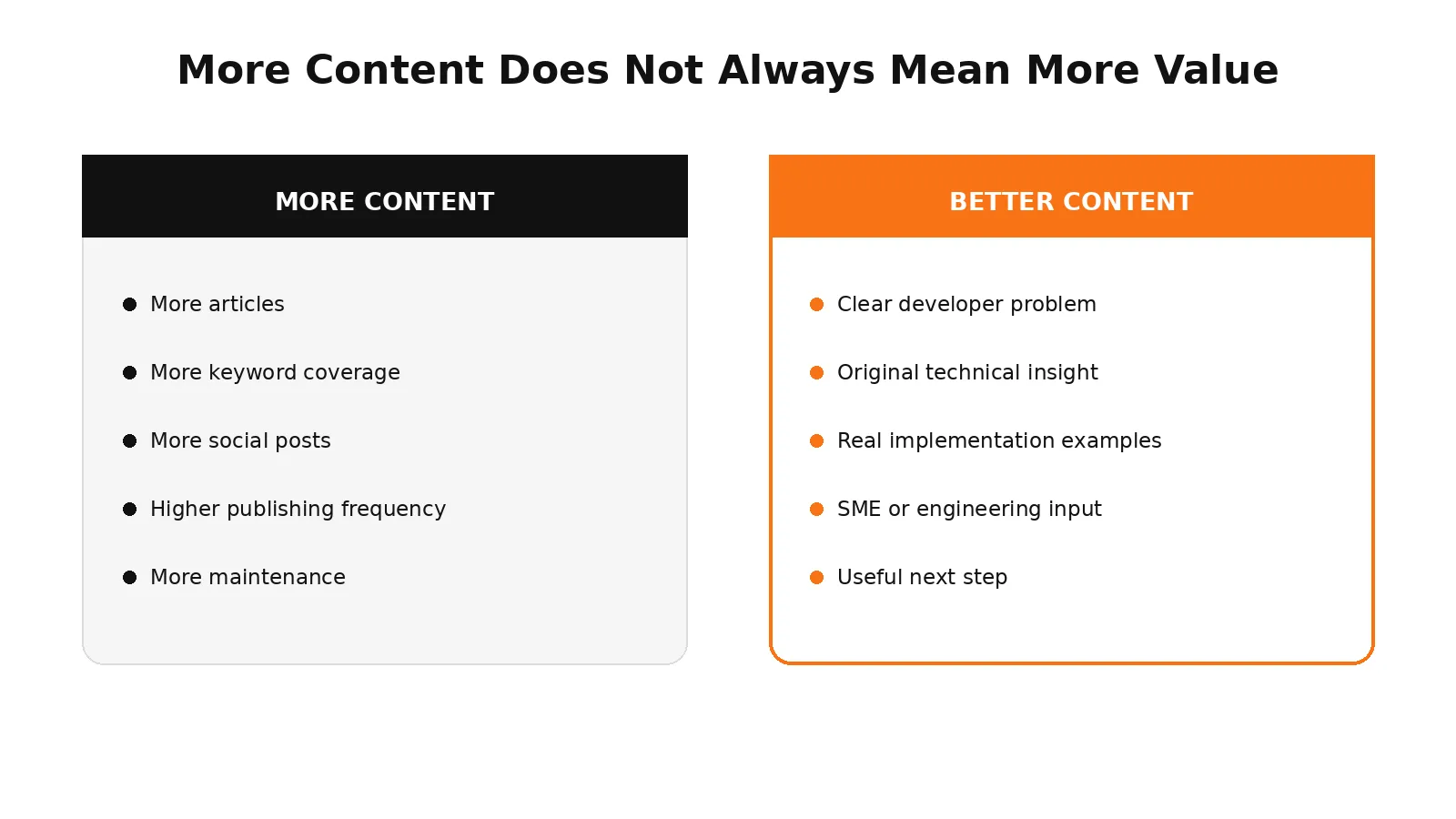
More content vs Better content
Conclusion
For us, the answer is not simply "quality over quantity." Developer marketing needs enough content to answer the questions developers have across discovery, evaluation, adoption, and continued use. But volume should follow usefulness. The better approach is to start with the developer problem, identify what existing content is missing, bring in real technical or customer experience, and then decide whether a new piece is needed.
Once the idea has something worth saying, AI can help produce and distribute it much faster. That is where we see the strongest balance. The goal is not to publish less. The goal is to make sure that publishing more does not become a substitute for having something useful to say.
AI can produce a polished technical article in minutes, but it may still include inaccurate explanations, unrealistic examples, or missing limitations.
Learn how paid campaigns support developer marketing, from targeting technical audiences and building trust to measuring product adoption and conversions.
 Enlear