Many businesses still think blog articles are the main way to appear in Google and AI search tools. Blogs are important, but they are not the only content type that matters now.
When a website needs to bring traffic and also turn visitors into leads or customers, conversion-based SEO landing pages become very important. These pages are not just written for ranking. They are created to answer a specific search need and guide the visitor toward taking action.
This is not a simple thing to build. A good SEO landing page takes keyword research, search intent understanding, clear writing, testing, and time. Results do not usually come quickly. But when these pages are planned properly, they can slowly help a website become easier for both search engines and AI tools to understand.
AI tools like ChatGPT, Claude, Perplexity, and Gemini often look for clear and well-structured information. If a landing page explains a product, service, or solution in a simple and focused way, it becomes easier for AI tools to understand what the page is about and when it may be useful.
Why Are SEO Landing Pages Important?
SEO landing pages are important because they focus on one clear keyword or search intent.
A blog post usually explains a topic in a broader way. But a conversion-based landing page is more focused. It speaks to a visitor who already has a specific need and may be closer to making a decision.
For example, a blog article may explain why email marketing is useful. But a landing page targeting “email marketing software for small businesses” can directly explain why that solution is suitable for small business owners.
This type of page is helpful because the visitor is not only looking for general information. They may be comparing products, checking services, or trying to decide what solution fits them best.
A strong SEO landing page can explain the problem, introduce the solution, answer common questions, and guide the visitor to the next step. This gives search engines and AI tools a clearer reason to understand, trust, and recommend the page.
How Do Conversion Pages Support AI?
AI search tools need clear and direct information to understand a page properly.
A conversion-based landing page usually gives this information in a more focused way than a general blog article. It can clearly explain who the product or service is for, what problem it solves, and why it is useful.
These pages can include product details, service benefits, use cases, comparisons, pricing information, and FAQs. This kind of content helps AI tools connect the page with specific user questions.
For example, if someone asks ChatGPT for the best project management software for agencies, a focused landing page can be more useful than a general blog post. The page can explain the audience, the problem, the features, and the reason the product fits that need.
But this takes time to create properly. You cannot just write a short sales page and expect results. The page should be clear, useful, and structured in a way that both beginners and search tools can understand.
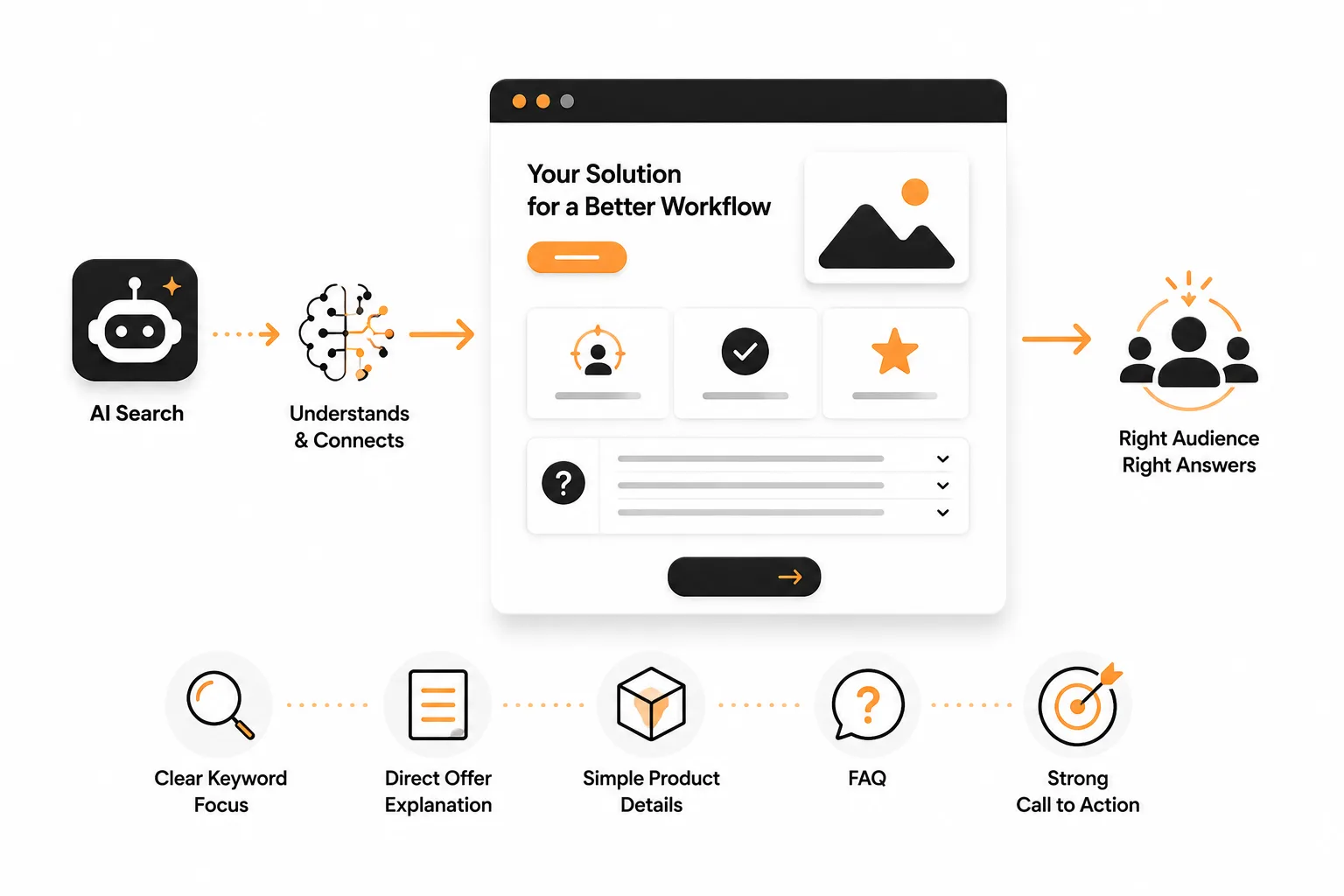
Quick landing page elements to include:
-
Clear keyword focus
-
Direct explanation of the offer
-
Simple product or service details
-
Common questions and answers
-
Strong call to action
What Should Each Landing Page Target?
Each landing page should target one specific keyword or user intent.
If one page tries to cover too many topics, it can become confusing. Search engines may not clearly understand what the page should rank for, and visitors may not feel the page is written for their exact problem.
The better approach is to create separate landing pages for different needs.
For example, a SaaS company can create one page for “CRM software for startups” and another page for “CRM software for real estate teams.”
Both pages may talk about the same product, but the message should not be exactly the same. Each page should match the audience, the problem, and the search intent behind that keyword.
This makes the content more relevant. It also helps AI tools understand when your page should be mentioned in an answer.
A specific page is usually stronger than a general page because it speaks directly to one type of user. That is why keyword targeting is very important for conversion-based SEO landing pages.
How Can Different Businesses Use Them?
Different businesses can use conversion-based SEO landing pages in different ways.
The structure may change depending on whether the business sells products, services, or software. But the main idea stays the same: create a page for a specific audience with a specific need.
For e-commerce websites, landing pages can focus on product categories or buyer needs. A page can target keywords like “best running shoes for beginners” or “organic skincare products for dry skin.”
For service businesses, landing pages can focus on specific services and locations. A marketing agency can create pages like “SEO services for SaaS companies” or “content marketing agency for startups.”
For SaaS companies, landing pages can focus on use cases, industries, features, or alternatives. These pages help users understand how the software solves their exact problem.
This process takes time because each page needs its own keyword, angle, structure, and explanation. But when it is done properly, the website becomes stronger because it has more focused pages for different search needs.
What Makes These Pages More Useful?
A useful landing page should not feel like a hard sales page from the first line.
Before asking the visitor to take action, the page should show that it understands their problem. This is important because beginners and new visitors usually need clarity before they trust a product or service.
The page should explain what the visitor is looking for, why the problem matters, and how the product or service can help. This creates a smoother flow from search intent to solution.
Good landing pages also answer questions before the visitor has to ask them. These questions can include:
-
Who is this solution for?
-
How does it work?
-
What makes it different?
-
What problem does it solve?
-
What should the visitor do next?
The language should be simple and direct. If the page is too vague or full of marketing words, users may not understand the value. AI tools may also find it harder to understand what the page is really about.
A strong landing page should also include a clear call to action. After reading the page, the visitor should know exactly what to do next.
What Is the Final Takeaway?
Blog posts are still useful for SEO, but they should not be the only focus.
If your goal is to appear in Google and AI search tools, conversion-based SEO landing pages need serious attention. These pages help connect specific keywords with clear business solutions.
But this is not a quick or simple process. It takes time to research keywords, understand the audience, build the right page structure, write clearly, and improve the page after publishing.
Conversion-based SEO landing pages can work well for e-commerce brands, service businesses, and SaaS companies when they are created around real user intent.
The best approach is to build focused pages that answer specific questions, explain the offer clearly, and guide visitors toward action.
When your landing pages are useful, simple, keyword-focused, and easy to understand, they have a better chance of being ranked, trusted, and recommended by both search engines and AI tools.
 Enlear